Two independent artists release the same caliber of song on the same Friday. Same genre. Same distributor. Same upload process. Ninety days later, one has 300 streams and a flat line in Spotify for Artists. The other has 24,000 streams, a placement on an algorithmic playlist, and 200 new followers.
The difference is not the song. Both are well-made. Neither has a label. Neither spent money. And this isn't luck, because it happens predictably, not randomly.
The difference is that one artist understood how music discovery actually works in 2026. The other was still operating from a mental model that stopped being accurate around 2010.
This article is about giving you that model.
The Old Way vs. How Music Actually Gets Discovered Now
For most of the 20th century, the music industry ran on a broadcast model. The logic was simple: make music, get it in front of people through radio, press, or a label push, and fans would find you. Distribution was the bottleneck. If you could get your music into rooms where people were listening, the numbers followed.
Today, music discovery is driven by algorithms: the automated recommendation systems built into Spotify, TikTok, YouTube, and Instagram. These systems don't respond to what artists tell them. They learn from what listeners do. Specifically, they read behavioral signals: saves, replays, playlist adds, shares, and profile follows. These are the signals that tell an algorithm this listener genuinely connected with this music, and that it's worth surfacing to more people who are likely to feel the same way.
When a playlist or algorithm serves your song without the listener actively choosing it, that's a passive stream, and it carries almost no algorithmic weight on its own. The algorithm isn't asking "did this person hear the song?" It's asking "did they want to hear it again?"
You can have 10,000 streams and zero algorithmic momentum if nobody saved the track. You can have 800 streams and strong algorithmic momentum if 15% of listeners saved it. Stream volume without behavioral signals produces no algorithmic momentum. This is why chasing stream counts is a trap. Two artists with identical songs can end up in completely different places ninety days after the same release.
Promotion in 2026 works differently. The goal is to create conditions where the right listeners encounter your music, respond genuinely, and generate the behavioral signals that tell the algorithm to keep surfacing it.
What Streams Are and What They're Not
Before any tactics make sense, it's worth getting the ROI frame right. Specifically: streaming royalties are not a meaningful return on promotional investment, and treating stream counts as a measure of success leads to a string of expensive, demoralizing decisions.
Spotify pays approximately $0.003–0.005 per stream. At that rate, you'd need roughly 150,000–200,000 streams to earn $500. The math simply doesn't support spending money on promotion and measuring the result in streams.
What streams actually are is more complex, and more useful. They're a proxy signal: a rough indicator of exposure, not of quality or connection. They're a data point inside a larger behavioral picture that only becomes meaningful when you look at it alongside your save rate (saves divided by streams, the clearest indicator of genuine listener intent on Spotify), your streams-to-listener ratio (total streams divided by unique listeners; a ratio above 1.5 means people are coming back), and the source of those streams. And streams are a lagging indicator: they follow genuine engagement rather than creating it.
What streams are not: a measure of success on their own, a return on promotional investment, or evidence that the algorithm will continue to push your music.
The goal of promotion is to find listeners who genuinely respond to your music, collect the behavioral signals that tell the algorithm it's worth recommending, and build an audience that belongs to you, not one borrowed from a playlist that can be updated tomorrow.
Why Most Independent Artists Stall Out Early
The patterns that cause stalled growth aren't your personal failures. They're structural mistakes that happen because nobody explained the model upfront. Most artists hitting these walls are working hard, releasing music they believe in, doing exactly what they think they're supposed to do.
The first pattern is promoting before validating. Artists spend money on ads or playlist pitching before confirming that any real listeners respond to the music organically. Paid promotion multiplies what already works. It doesn't create resonance that isn't there. The result is an expensive campaign that generates impressions and zero behavioral signals, because the song simply hasn't connected yet in any organic context. The campaign failed before it launched, because the sequence was wrong.
The second pattern is confusing exposure with connection. Getting a playlist placement or a TikTok post that drives streams feels like success. But if the listeners who hear the track don't save it, replay it, or follow the artist, the algorithm interprets that as a signal of rejection and stops surfacing the music. Borrowed reach that doesn't convert to behavioral signals is a dead end, and it will actively suppress your algorithmic reach going forward by training the platform that your music generates skips.
The third pattern is treating each release as a standalone event. Most artists promote hard for one to two weeks around a release, then go quiet and start again with the next song. Every release starts from zero. There's no compounding: no list of fans who get notified, no catalog for new listeners to explore, no data from previous releases to inform the next campaign. The artists who grow treat releases as chapters in a longer story: have consistent branding and images, post regularly on socials. And slowly but surely things will grow. It's a compounding effect. The practical version of this is a release every 4–8 weeks rather than one album every two years.
The fourth pattern is starting with tactics before building the foundation. Asking "how do I run TikTok ads for my music?" before having a clearly defined artist identity, a properly set up streaming profile, and a track that has shown any organic resonance is like running paid traffic to a website that doesn't exist yet. Tactics require a foundation that most artists haven't built yet.
The 5 Building Blocks of Music Promotion and Why the Order Matters
What follows is the framework that the rest of this series is built around. These aren't five options to choose from; they're a sequential stack. Each block has to be in place before the next one becomes effective.
Block 1: Identity
Before any promotion can work, you need a clear, consistent signal that the algorithm can use to route your music to the right listeners, and that potential fans can use to decide, in seconds, whether your music is for them.
Sound consistency, genre clarity, visual coherence, and the bio language you use to describe yourself: these are the signals the algorithm reads to route your music, and the signals a potential fan reads to decide whether to stay. An unclear identity produces confused algorithmic routing, which produces weak behavioral signals, which produces stalled growth. Genre tags and metadata play a far more significant role. The listener retention data indicates that most people find music through 'similar artists' recommendations. The algorithm routes your music based on what you tell it, and what your existing listeners tell it.
Block 2: Release
The mechanics of releasing music correctly are not intuitive. Most artists get this wrong in ways that cost them permanently.
There is a 6–8 week window before release during which the most important actions happen: submitting the Spotify editorial pitch (which closes 4–6 weeks before the release date), building a pre-save campaign for your existing audience, and preparing the organic content that will accompany the launch. Missing these windows means the release starts from zero on day one instead of arriving with momentum already built. Uploading to a distributor is the technical step inside what should be a much larger campaign.
Block 3: Content
Organic short-form content on TikTok, Instagram Reels, and YouTube Shorts is the most accessible discovery engine available to an independent artist right now, and it costs nothing. More importantly, content that connects organically is proof that the music lands with real listeners. That proof is what you need before you consider spending money on ads.
The key distinction that separates content that works from content that doesn't: posting clips that just say "check out my song" generates almost nothing. What works is content that gives listeners a reason to self-select in: the story behind the track, the emotion it came from, something specific and human. Organic content is the first stage of promotion, and the testing ground for every paid creative that comes later.
Block 4: Audience
Every stream that happens on a platform you don't control is a listener you can lose the moment an algorithm changes or a playlist gets updated. An owned audience — an email list, an SMS list, a Discord community is an audience you can reach directly, for life, regardless of what Spotify or TikTok decides to do.
Email lists convert at roughly 5–10 times the rate of social media followers for release announcements, because you own the channel and algorithm changes don't affect it. Building even a small list, 200–500 people before a major release, dramatically outperforms purely social promotion at the same scale. The email list starts at Block 2 (a landing page for your pre-save campaign) and grows from there. This is the most underbuilt asset in independent music, and it's the difference between a career and a series of spikes on a dashboard.
Block 5: Amplification
Paid promotion works, but only when Blocks 1 through 4 are in place.
The mechanism is specific: paid promotion reaches a cold audience with your music. If that audience saves the track, follows your profile, and replays it, the algorithm reads those behavioral signals and begins surfacing the music to similar listeners organically. Artists running effective campaigns consistently report an additional 15–40% lift in organic streams through Discover Weekly and Radio. The campaign partially pays for itself by triggering algorithmic reach it didn't directly buy. But when that cold audience doesn't respond (because the identity is unclear, there's no landing page to capture the conversion, or the music hasn't shown any organic resonance), the campaign costs money and produces nothing. Ads find more of the same listeners who already responded. If no one has responded yet, there's nothing to find more of.
Before Your Next Release: The Starting Checklist
Before building any campaign, make sure these foundations are in place. If anything here is missing or unclear, fix it before the next release. These are the signals the algorithm uses to route your music to the right listeners. Gaps here cost you in every subsequent step.
Artist identity basics:
- Can you describe your sound in one sentence that references genre and emotional territory without using the phrase "I don't sound like anyone else"?
- Do your last three releases sound like they came from the same artist?
- Does your artist bio on Spotify, Apple Music, and Instagram say something specific, or does it describe you the way every other artist describes themselves?
- Do your profile photos and cover art share a visual language, or does each release look like a different person made it?
Digital presence basics:
- Have you claimed and verified your Spotify for Artists profile?
- Is your artist photo current and high-resolution?
- Is your bio filled in and specific?
- Are your social links connected?
This checklist takes under three minutes to complete. If you're answering "no" or "I'm not sure" to more than one or two of these, those are the gaps to close first.
Where This Series Goes from Here
This article has covered the model. The rest of the series covers the mechanics.
Article 2 — Is Your Music Actually Ready to Promote? Before building a campaign, make sure the track itself is ready to meet professional ears. There's a step here that most guides skip entirely, and skipping it explains a lot of underperforming releases.
Article 3 — How to Release Music Independently: The 6-Week Runway. A week-by-week plan for the campaign that surrounds every release, from distributor setup to post-release sustain.
Article 4 — How to Promote Your Music Without Spending a Dollar. The organic promotion framework: short-form content, playlist pitching, collaborations, and how to know when you have enough validation to consider spending money.
Article 5 — What Your Spotify Data Is Actually Telling You. How to read save rate, streams-to-listener ratio, and source of streams, and what the numbers tell you before you run your first paid campaign.
Article 6 — Paid Music Promotion: When to Start and How It Actually Works. The architecture of a paid campaign: funnel structure, platform overview, and the checklist that tells you whether you're ready.
Article 7 — Building a Music Promotion System That Compounds Over Time. How to shift from release-by-release thinking to a system where each release builds on the last.
One more thing worth saying before you go: the artists who grow aren't necessarily more talented, more connected, or better funded. You have to consistently work on your strategy and be prepared to iterate without seeing immediate results. Think about it this way: you can read all the books in the world on how to play the guitar, know all of the chords, but you still have to practice to actually be able to play music.
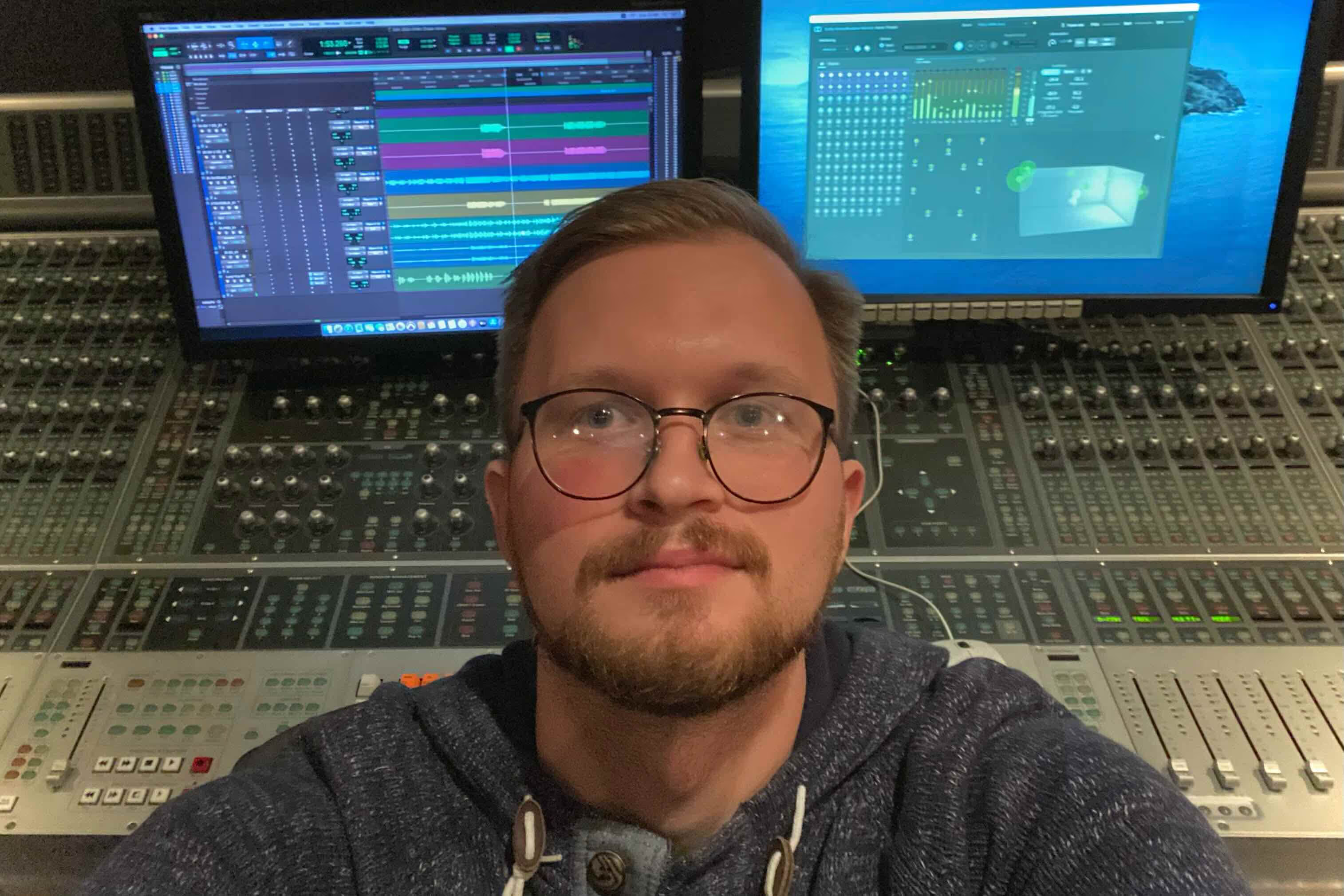
About GK.Mixing | Online Mixing and Mastering
Before focusing on audio, I spent years in the music industry as a Product Marketing Manager at a Yamaha subsidiary, where I was responsible for Steinberg, the software and hardware behind countless professional studios worldwide. That background gave me a rare perspective: I understand both the technical side of music production and the business side of being an artist.
On this blog, I write about getting great-sounding mixes, navigating the mastering process, and helping artists actually get heard.